Head-to-head
NMI vs Authorize.net (2026)
Both carry card data from your checkout to the processor that pays you. One is infrastructure sold through ISOs and software platforms, the other a Visa-owned small-business gateway with prices on its sign-up page.

By Marcus Flynn, tracking and attribution editor. Updated 11 October 2026.
Pick NMI if you need multiple MIDs routed through one gateway account behind a custom checkout or ISO stack; pick Authorize.net if you want published $25 gateway pricing, plug-in ecommerce integrations, or a bundled merchant account under a familiar small-business brand.
Quick answer
NMI is our top pick for most people. NMI is an embedded payments platform for ISOs, software vendors and resellers, with a white-label gateway as one of its modules. For a merchant it is the gateway behind many ISO and high-risk programs, chosen for multi-MID routing and a long processor list, and priced by whoever sells it to you.
- NMI. Best for Operators and platforms that route volume across several merchant accounts through one gateway.
- Authorize.net. Best for Small businesses that want online signup, standard cart plugins and a monthly fee known in advance. From $25/mo.
Side by side
| Tool | Built for | Pricing | Multi-MID | Connects to | Signup | From |
|---|---|---|---|---|---|---|
| NMI | ISOs and software platforms | Quoted | Yes, rules-based | 200+ processors | Sales or reseller | Not listed |
| Authorize.net | Small businesses | Published plans | Not advertised | 170+ cart plugins | Online | $25/mo |
NMI: pros and cons
What works
- One gateway account can hold several merchant IDs, and Transaction Routing picks the MID for each charge from the routing directives you set.
- Its gateway page lists integrations with 200+ payment processors and 125+ shopping carts, so the gateway can follow whichever processor approves you.
- A Gateway Emulator lets software written for another gateway point at NMI without reprogramming, which shortens a migration.
- The gateway is white-label and built to be resold, which is why so many ISOs and software platforms put it under their own brand.
What to watch
- There is no public price list. The site sends you to its sales team, and resellers on r/PaymentProcessing report a $100 monthly minimum on direct partner contracts.
- Integrators who chose it for white-label work still describe the developer experience as dated.
- Payment professionals on Reddit tell merchants to read its Trustpilot reviews before signing.
Authorize.net: pros and cons
What works
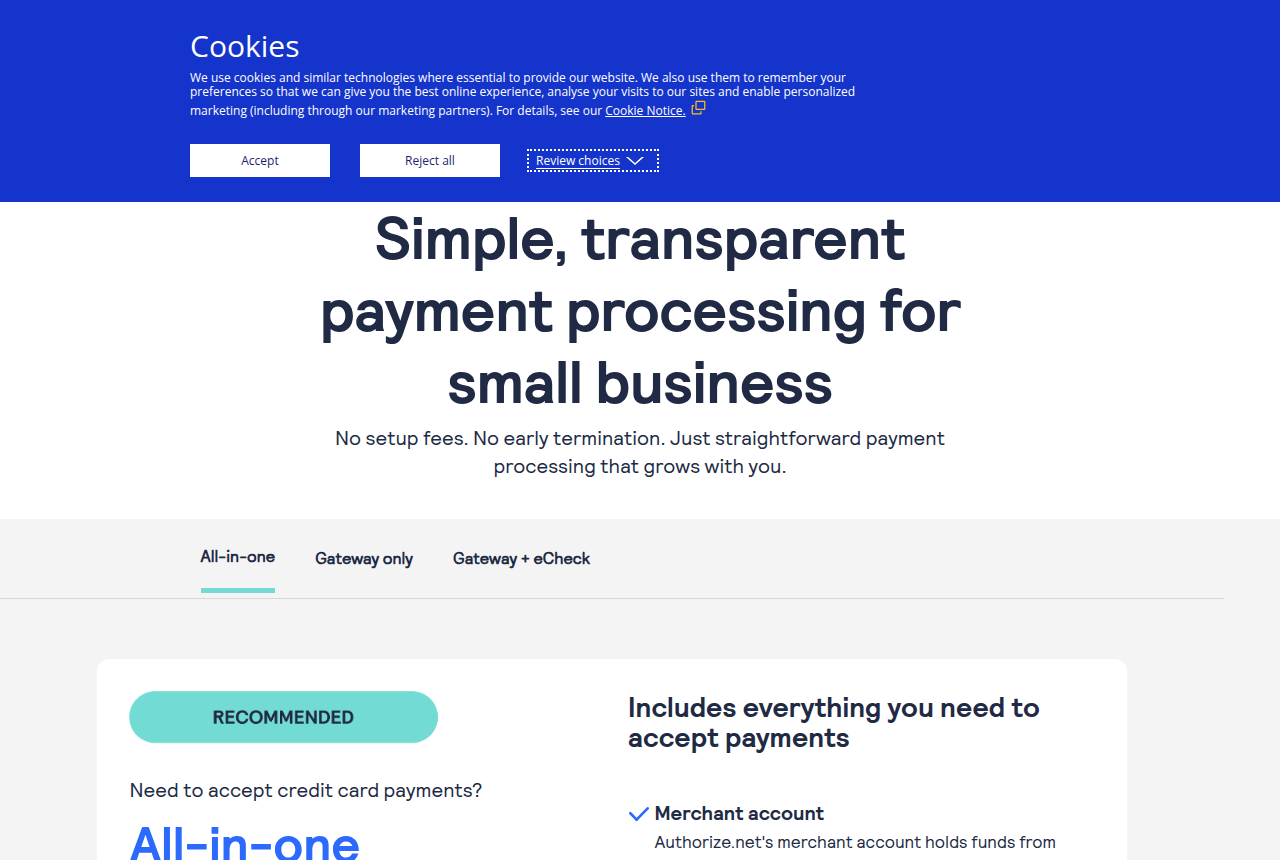
- Prices for all three plans sit on its signup page, so the gateway cost can be modelled before you talk to anyone.
- Pre-built plugins cover Shopify, WooCommerce, BigCommerce, Magento and 170+ other platforms, alongside a REST API and hosted payment fields.
- The Advanced Fraud Detection Suite, with configurable real-time filters, comes with every account at no extra cost.
- Its homepage advertises 24/7 human support.
What to watch
- None of the pages we read advertise sending one gateway account's charges to several merchant IDs, a gap you feel once volume is split over more than one MID.
- Users describe its bundled merchant account as more risk averse than other processors, which narrows who gets approved on that plan.
- A critical G2 review on the Authorize.net vs NMI comparison cites service interruptions and support that did not help.
The real differences
NMI gateway vs Authorize.net: two different buyers
A payment gateway takes the card details from your checkout, sends them to the processor and returns an approval or a decline. Both companies do that job. Their own websites show who each one expects to sell to.
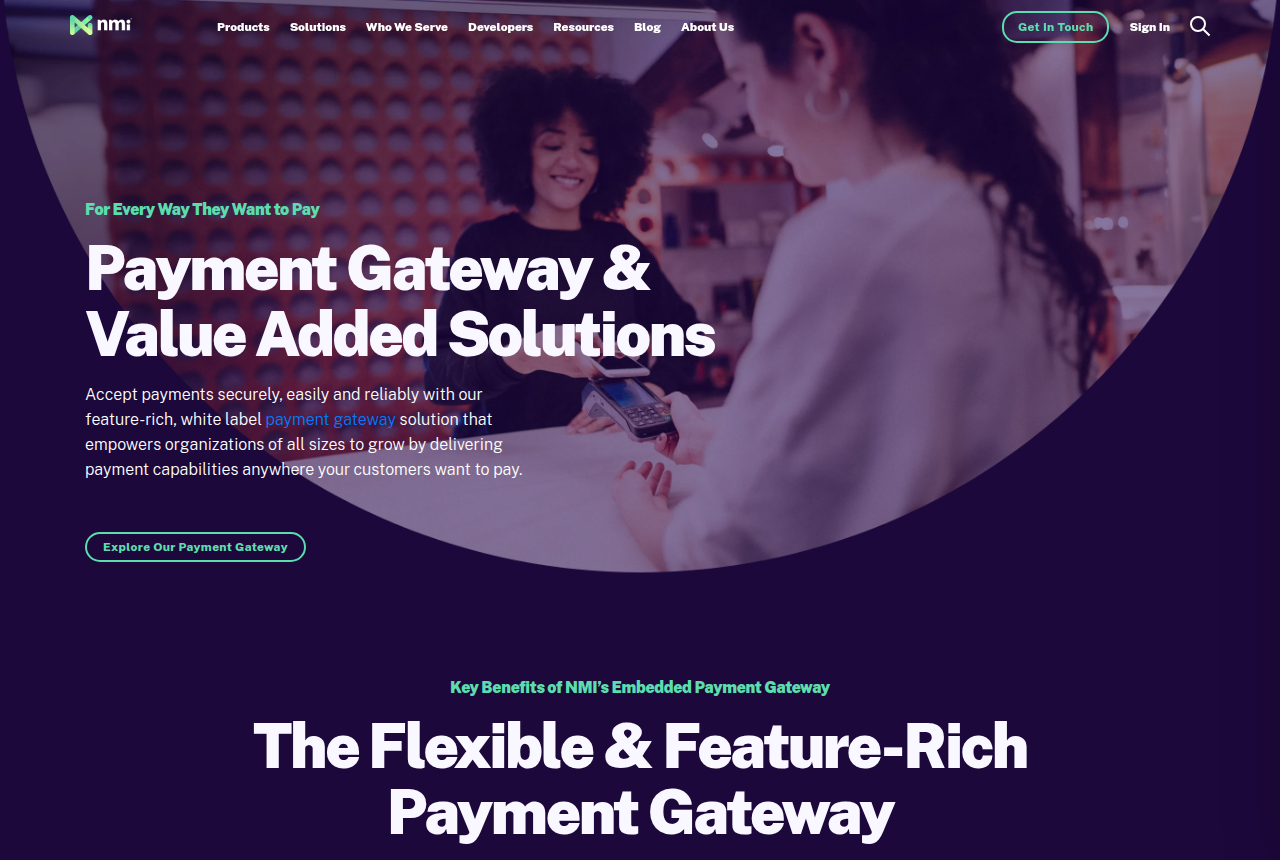
NMI's homepage addresses ISOs and software vendors first, pitching its omnichannel platform as a way for an ISO to add value and grow revenue. The white-label gateway is one module beside NMI Payments and Merchant Central, and the homepage counts 1.2 million active merchants, 6,000 channel partners and more than $700 billion in yearly payments volume. Most merchants meet NMI through a reseller, an ISO or a platform that embeds it, often under another name.
Authorize.net speaks to the merchant directly. It is owned by Visa, its homepage leads with fraud prevention and round-the-clock human support, and its plans are priced on a public signup page. A store owner can choose a plan and apply online without a sales call.
That difference decides most of what follows. With NMI you are choosing infrastructure, and the commercial terms come from whoever boards you. With Authorize.net you are buying a finished product at a list price.
Multi-MID routing: why direct-response operators shortlist NMI
Offers on cold paid traffic often outgrow one merchant account. A processor caps monthly volume, or chargebacks on one MID climb, and the operator adds a second and third account to spread the load. The gateway then has to decide which MID takes each charge.
NMI sells that as a feature. Its payment gateway page describes onboarding several MIDs on a single gateway account, with Transaction Routing that "automatically determines which MIDs to route transactions to based on active routing directives." The same page lists 200+ payment processors and 125+ shopping carts, so moving to a new processor rarely means moving gateways.
The Gateway Emulator matters if you are switching. NMI says it lets you "migrate from other gateways without having to rework or reprogram software or applications," so a checkout or CRM already wired to another gateway can be pointed at NMI instead. Ask your platform whether it supports the emulator before you count on it.
Many direct-response checkouts and subscription CRMs already route across merchant accounts on their own side. If yours does, you may only need the gateway to carry each charge, and NMI's routing becomes a second layer you might not use.
Authorize.net's three plans, and when gateway only wins
Every Authorize.net plan carries the same monthly fee. They differ in what sits behind the gateway.
- The bundled plan pairs an Authorize.net merchant account with the gateway at a flat card rate. It is the fastest way to start taking cards if you have no processor yet.
- Gateway only assumes you already hold a merchant account elsewhere and charges a small per-transaction and daily batch fee for carrying the traffic.
- Gateway plus eCheck adds bank-account payments for merchants who take them.
An operator who already has a merchant services provider, or who was approved by a high-risk ISO, almost always wants gateway only. The processing rate then comes from that provider, and Authorize.net is paid just to transmit. The pricing section below works through the gap at a realistic volume.
Authorize.net also lists plugins for Shopify, WooCommerce, BigCommerce, Magento and 170+ other ecommerce platforms, and every account includes its Advanced Fraud Detection Suite at no extra cost. A standard store can be live quickly.
High-risk: the gateway does not approve you
Searches for either name often come from merchants in nutraceuticals, continuity offers or other verticals that banks treat as high risk. The approval decision belongs to the merchant account provider and the acquiring bank behind the gateway. Neither gateway can make a vertical bankable by itself.
That is why so much blame lands on the wrong company. In an r/smallbusiness thread about held funds, an experienced commenter points out that "Authorize.net is usually just a gateway, they don't collect or hold funds." Reserves and holds are set by whoever underwrote you. The exception is Authorize.net's bundled plan, where it is also your acquiring side, and users in the same thread call it "much more risk adverse than other merchant processors."
NMI turns up in high-risk programs because ISOs that specialise in those verticals board merchants onto it and route across the MIDs they arrange. Your terms, reserves and fees then come from that ISO. Whether a given vertical gets accepted on either side is a question for the provider's underwriting team, and no gateway marketing page answers it.
What users report
On NMI, the useful voices are resellers and integrators. One reseller on r/PaymentProcessing describes a monthly minimum for partners who sign directly, billed to the partner when merchant volume falls short. Another tells a merchant to read the Trustpilot reviews before signing. Developers building card-present software call it a common white-label choice whose "developer experience definitely feels dated."
On Authorize.net, complaints split between fund holds, which usually trace back to the processor that underwrote the merchant, and reliability. A critical review on G2's Authorize.net vs NMI page describes service interruptions and support that did not help when the business needed a fast fix.
Where your checkout and CRM fit
A gateway is one layer of the stack. The checkout page, the upsell flow, rebilling and the decision about which MID takes a charge often live in a CRM or checkout platform that connects to the gateway. If you are choosing that layer too, read Konnektive vs Sticky.io for subscription CRMs and our Checkout Champ review for a hosted direct-response checkout. Pick the platform first, then the gateway it supports best.
What each one costs
Authorize.net prints its prices, and its bundled plan includes a merchant account at the card rate shown. NMI sends buyers to its sales team, and most merchants pay whatever the ISO or reseller that boards them sets, so its line can only be filled in with a quote.
| Plan | Monthly | Per card sale | Daily batch | eCheck |
|---|---|---|---|---|
| Authorize.net bundled | $25 | 2.9% + 30¢ | None | None |
| Authorize.net gateway only | $25 | 10¢ | 10¢ | None |
| Authorize.net + eCheck | $25 | 10¢ | 10¢ | 0.75% |
| NMI gateway | Quoted | Quoted | Quoted | Quoted |
A worked example: 1,000 card sales of $50 in a 30-day month. The bundled plan's card rate comes to $1,750, so the bill for that month is $1,775 once the plan fee is added. On gateway only, Authorize.net takes the plan fee, ten cents a sale and ten cents a day, $128 in total, and your own processor's rate sits on top of that. Interchange and processing costs flow through the processor on every gateway, so the gateway line is only part of the bill.
To compare NMI fairly, ask the ISO or reseller to quote that same month: the gateway fee, any monthly minimum, the per-transaction charge and the cost of each extra MID.
Prices and buying terms checked on each vendor's own pages, current as of 12 October 2026.
Our pick
NMI
NMI is an embedded payments platform for ISOs, software vendors and resellers, with a white-label gateway as one of its modules. For a merchant it is the gateway behind many ISO and high-risk programs, chosen for multi-MID routing and a long processor list, and priced by whoever sells it to you.
Frequently asked questions
Is NMI a merchant account?
Can Authorize.net handle high-risk merchants?
Which one is cheaper?
Can I move from Authorize.net to NMI?
Do I still need a CRM or checkout platform?
Sources
From NMI and Authorize.net
- https://www.nmi.com/
- https://www.nmi.com/products/payment-gateway/
- https://www.authorize.net/
- https://www.authorize.net/sign-up/pricing.html
- https://www.authorize.net/payments/ecommerce.html
Other sources
4 discussions and reviews read for this page. Quotes are excerpts; open a link to read the original in context.
How we compared these
We do not run paid campaigns through either tool. We read each vendor's own documentation and pricing, verify every number against the source, and weigh the long-term reports of operators who run them at real spend. The full rubric is on the methodology page.