By Marcus Flynn, tracking and attribution editor. Updated 14 September 2026.
Quick answer
RedTrack is our top pick for most people. The default first tracker for most direct-response buyers: CAPI on every plan, ad-level spend sync, and an entry price a solo operator can carry.
- RedTrack. Best for Multi-channel paid-social buyers. Has a free tier.
- Hyros. Best for High-ticket info, webinar and call funnels.
Side by side
| Tool | Server‑side CAPI | Anti‑fraud kit | Self‑hosted | From |
|---|---|---|---|---|
| 1. RedTrack | ✓Yes | ×No | ×No | Free tier |
| 3. Hyros | ✓Yes | –Unknown | ×No | Not listed |
RedTrack: pros and cons
What works
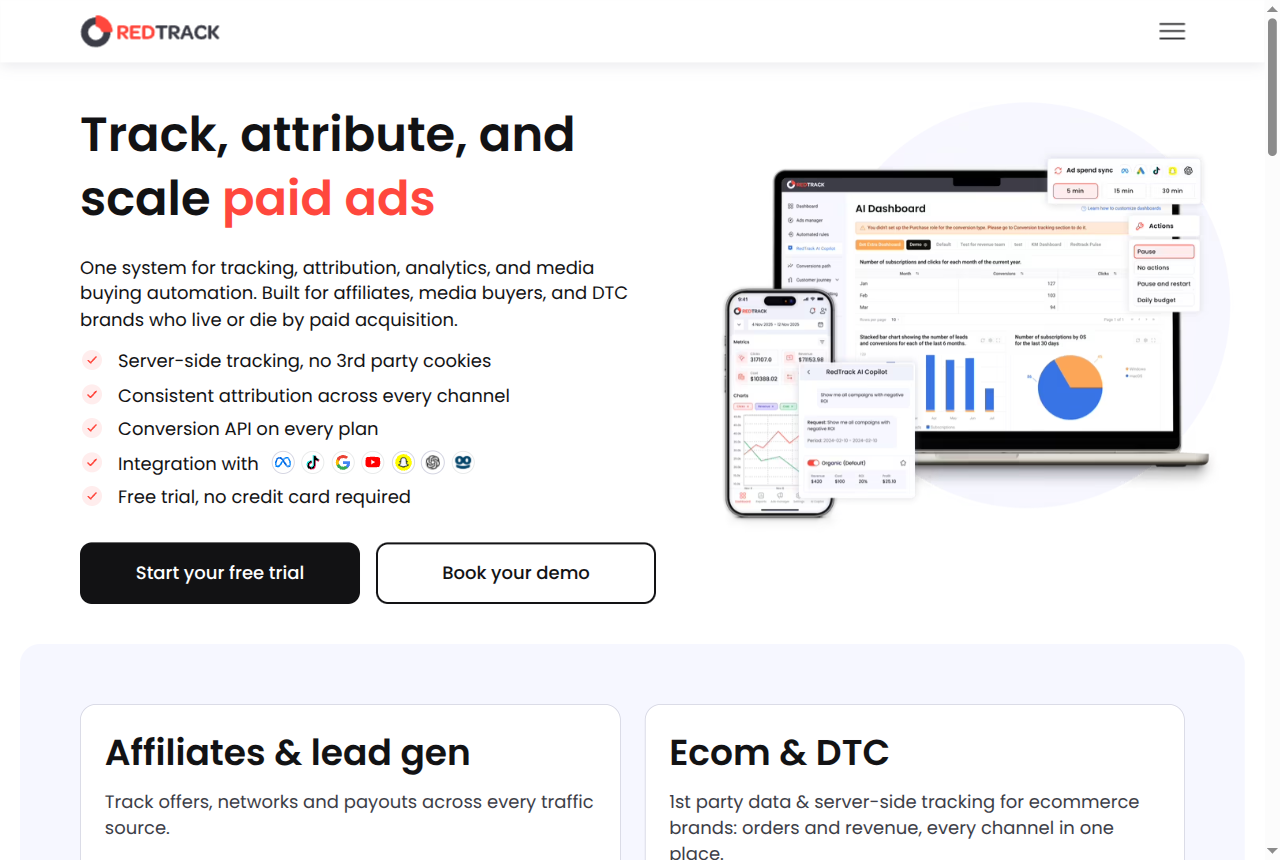
- Server-side CAPI for Meta, TikTok, Google and Snapchat is included from the $69 Builder plan, where several rivals gate it behind four-figure tiers.
- Ad-spend sync down to the ad level means ROAS and CPA reflect what was actually spent, not a number hours out of date.
- Sits between a pure click tracker and a revenue-attribution suite, so one tool covers affiliate offers and owned DTC.
- Published, tiered pricing all the way up to Agency, so you can forecast cost as you scale seats and events.
What to watch
- The fresh ad-spend sync speeds (5 and 15 minute) and the Ads Manager control layer are paid add-ons on top of the plan, so the real monthly cost at scale runs above the headline price.
- It is a media-buying tracker, not a full multi-touch attribution suite for long, call-heavy sales cycles; buyers who need that look at Hyros.
- Setup still asks for clean UTMs, working pixels and CAPI hygiene. It surfaces tracking gaps, it does not paper over them.
Hyros: pros and cons
What works
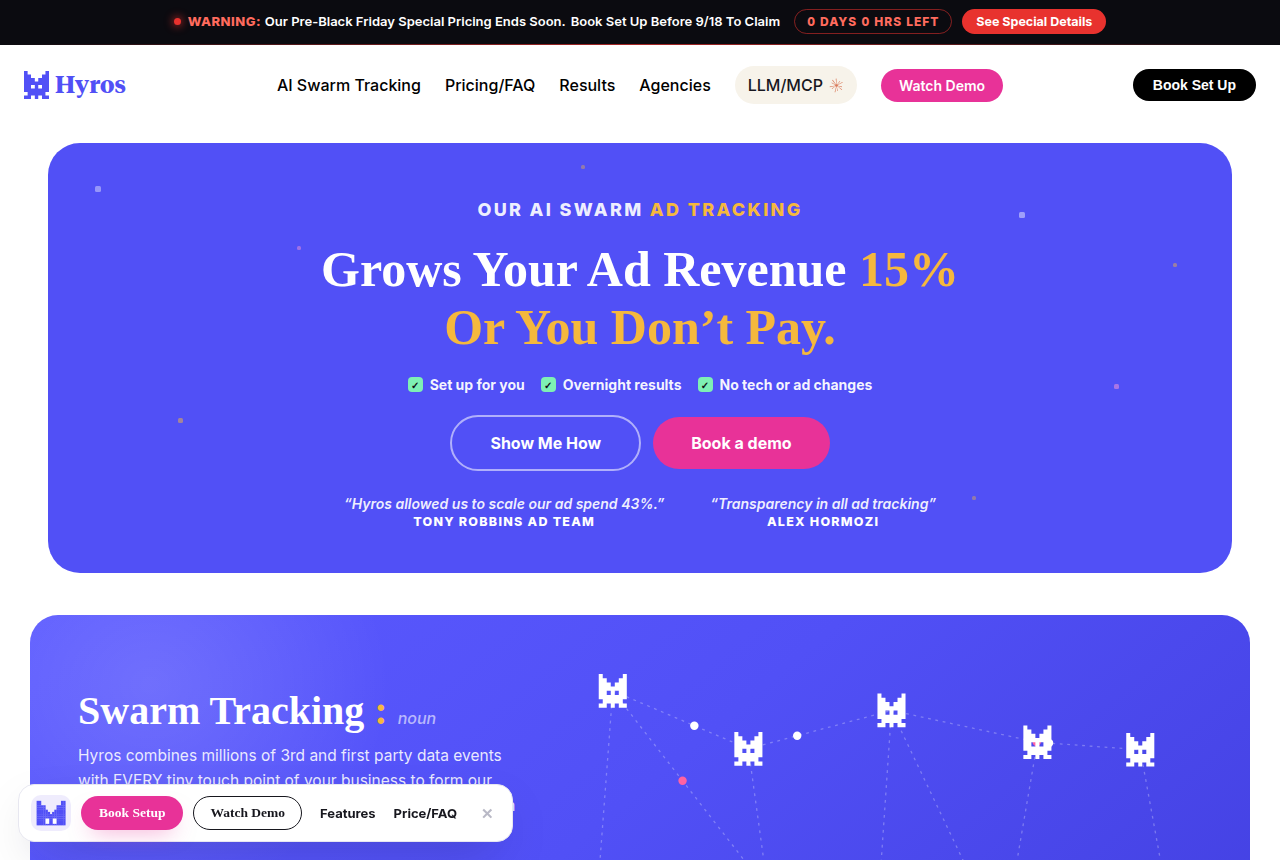
- Multi-touch attribution across a long journey (ad to opt-in to email to webinar to booked call), which last-click platforms miss.
- Sends offline and long-window sales back to Meta and Google so their algorithms optimize on real revenue.
- Call and high-ticket tracking is a first-class use case, not an afterthought, with named case studies from large info brands.
What to watch
- Hyros does not publish plan prices; cost is quoted after a demo and is aimed at higher-spend accounts, so it is opaque before a sales call.
- Operators repeatedly report it is involved to set up and overkill below roughly $50k/month in spend across multiple platforms.
- It will not fix low Event Match Quality or a weak offer; it makes the attribution clearer, not the funnel better.
What each one costs
RedTrack. From $83 per month. Affiliate and lead-gen plans are priced by events and seats. Solo is $141/mo billed yearly ($169 monthly) with 5M events and one user. Team is $333/mo ($399 monthly) with 20M events and five users. Enterprise is $833/mo ($999 monthly) with 75M events and fifteen users. Overage costs $0.04 per 1,000 events on Solo, $0.035 on Team and $0.025 on Enterprise, and tracking keeps running past the cap. Ecommerce plans are priced by tracked revenue: Relay is free with UTM-based last-click attribution, Brand starts at $83/mo billed yearly ($99 monthly) and Agency at $499/mo ($599 monthly). Faster ad-spend sync is a paid add-on. Paid plans start with a 14-day free trial.
Hyros. Pricing quoted on request. Hyros publishes no plan prices. It sells one plan with everything included, and the price follows the revenue Hyros tracks for you. The figure is quoted on a setup call and is aimed at higher-spend accounts.
Prices and buying terms checked on each vendor's own pages, current as of 14 September 2026.
Our pick
RedTrack
The default first tracker for most direct-response buyers: CAPI on every plan, ad-level spend sync, and an entry price a solo operator can carry.
Frequently asked questions
Is RedTrack or Hyros cheaper?
Which should I pick?
How we compared these
We do not run paid campaigns through either tool. We read each vendor's own documentation and pricing, verify every number against the source, and weigh the long-term reports of operators who run them at real spend. The full rubric is on the methodology page.