Head-to-head
Polar Analytics vs Fospha
Both measure a DTC brand's marketing across channels, and neither is a click tracker. One is a Shopify data platform you own and operate; the other is a pixel-free model run for you.
By Marcus Flynn, tracking and attribution editor. Updated 28 September 2026.
Pick Polar Analytics if you want your whole Shopify store's numbers in editable profit dashboards on a data warehouse you own, with a first-party pixel and server-side conversions feeding Meta and Google; pick Fospha if you want pixel-free modeled measurement that credits demand-gen and marketplace channels from your store's real revenue, fully managed for you.
Quick answer
Polar Analytics is our top pick for most people. An ecommerce data platform that joins store, advertising and lifecycle records in a dedicated warehouse, then turns them into editable profit and marketing reports. Its first-party identity layer also sends selected conversions to Meta and Google. The trade-offs are quote-only GMV pricing and a reporting layer that users say can feel restrictive when attribution logic becomes highly specific.
- Polar Analytics. Best for Shopify brands centralizing profit and marketing reporting.
- Fospha. Best for Retail and ecommerce brands spending six figures a month that want modeled measurement instead of pixels. From $1,500/mo.
Side by side
| Tool | Server‑side CAPI | Anti‑fraud kit | Self‑hosted | From |
|---|---|---|---|---|
| 7. Polar Analytics | Yes | No | No (cloud) | Not listed |
| 13. Fospha | –Unknown | –Unknown | –Unknown | $1,500/mo |
Polar Analytics: pros and cons
What works
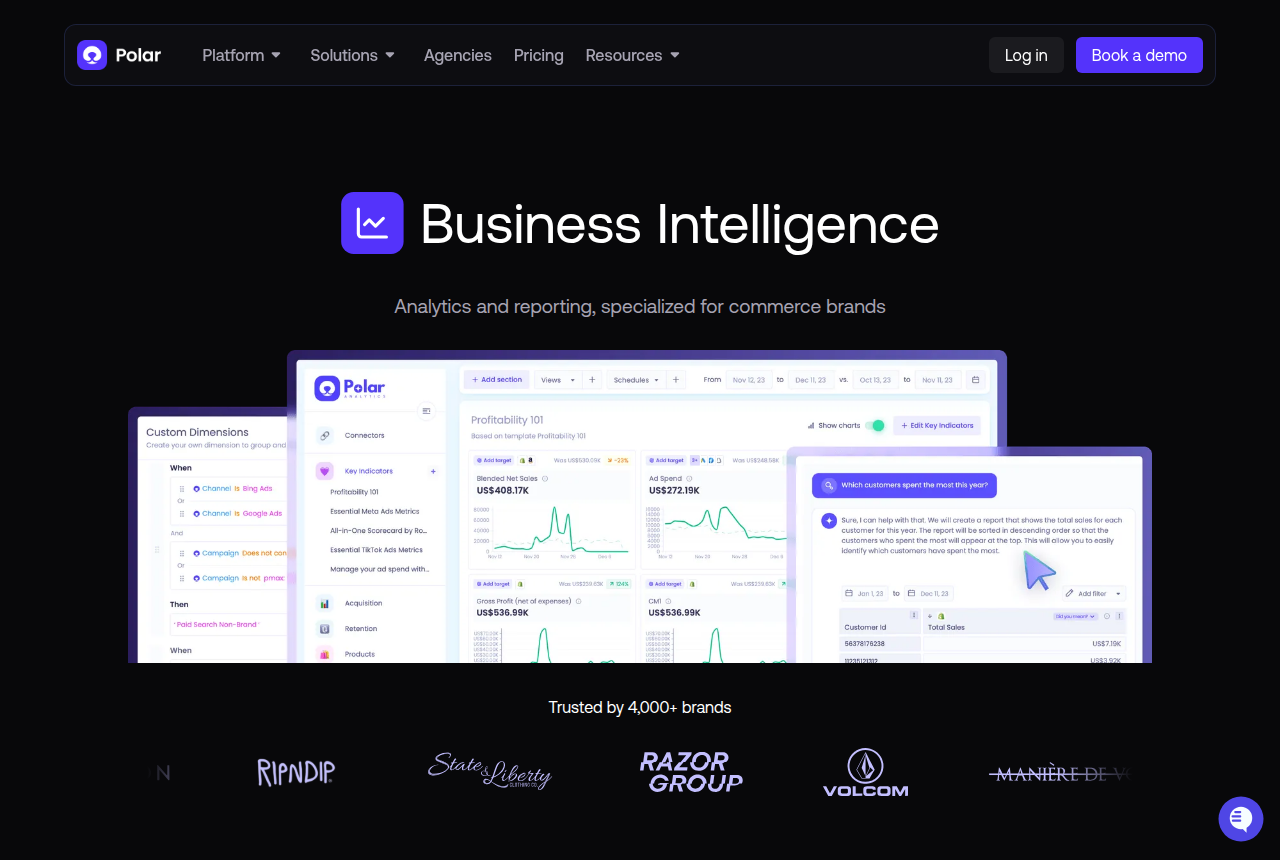
- Joins ecommerce orders, ad spend, email and customer history in one semantic layer with editable reports for CAC, MER, LTV, cohorts, products and contribution margin.
- Every plan includes a dedicated Snowflake database, unlimited users and unlimited historical data, so the business keeps an accessible data foundation rather than only a dashboard.
- A first-party pixel and Lifetime ID improve identity, while Advertising Signals sends conversion events to Meta and Google Ads.
- Incrementality Testing is available alongside Business Intelligence, with a dedicated data scientist and lift tests across digital, television and retail outcomes.
What to watch
- The vendor publishes no dollar price. Quotes are tiered by annual gross merchandise value after a demo, which makes procurement less predictable as the store grows.
- Operators praise the visual reporting but describe a ceiling when attribution needs custom logic or business-specific nuance. Polar now offers incrementality testing, but the broader platform still leads with ecommerce data and reporting.
- Its center of gravity is ecommerce. A brand without owned order, product and customer data will use less of the warehouse, merchandising and lifecycle reporting.
- The instant demo runs on sample data, not the buyer's store. A team still needs the sales process and implementation plan before it can validate its own connectors and definitions.
Fospha: pros and cons
What works
- Non-pixel measurement that credits the upper-funnel channels last-click misses. Because it models from 100% of your real store revenue rather than platform-reported conversions, it surfaces contribution from prospecting social, YouTube, TikTok and display that GA4 and in-platform ROAS tend to undercount.
- Well reviewed by the brands that use it: 4.5 out of 5 from 51 G2 reviews, with recurring praise for ease of use, support and finally seeing channel value that click tracking hid.
- Measures marketplaces, not just your own site. On Pro and up it models the halo from paid media into Amazon and TikTok Shop sales, which pixel-based DTC dashboards structurally cannot see.
- Daily outputs with forecasting, not a quarterly report. The model retrains daily and Beam projects returns at different spend levels, so it works as a budget-allocation tool and not just a scorecard.
- Fast, transparent onboarding: most clients are live in under 28 days with 24 months of historical data, and Fospha runs a glass-box model you can interrogate layer by layer rather than a black box.
What to watch
- No free trial and no self-serve sign-up. You book a demo and commit to paid onboarding before you see it work on your own data, so the only way to validate it is to buy it. Ask for two or three references from brands like yours before you do.
- The floor is high: Lite is $1,500 a month and is built for brands already spending $100k to $500k a month on media. Below roughly $100k a month of spend it is overkill, and its own pricing tiers say so.
- Pro adds a percentage of your media spend on top of a $2,000 base, and Fospha does not publish that percentage, so the true all-in cost is opaque until you talk to sales.
- It reports modeled estimates, not deterministic user-level tracking, so its numbers will not match Meta, GA4 or Shopify. That is the point of a mix model, but it means your team needs a governance rule for which source to trust, and Fospha itself says the ad-level view is directional, not creative-level truth.
- Reporting flexibility is a common gripe: G2 reviewers mention limited report editing, filtering and segmentation friction, and manual data work to get some cuts of the data. It is a measurement layer, not a build-your-own BI tool.
The real differences
What each one actually is
Polar Analytics is a Shopify-native analytics and business-intelligence platform for direct-to-consumer brands. It does not sit in your click path the way a tracker like Voluum or RedTrack does. It connects your store, ad platforms, email and the rest of your stack, then turns the lot into one set of dashboards: blended CAC and MER, ROAS, LTV, cohorts, retention and contribution margin, editable out of the box. Under those dashboards sits real infrastructure. Every plan includes a dedicated Snowflake warehouse you hold the keys to, an ecommerce semantic layer of pre-built metrics, and a first-party pixel with a Lifetime ID. Its Advertising Signals product pushes conversion events server-side to Meta and Google to lift Event Match Quality. The pitch is to stop your team reconciling platforms by hand and give everyone one profit picture on data they own.
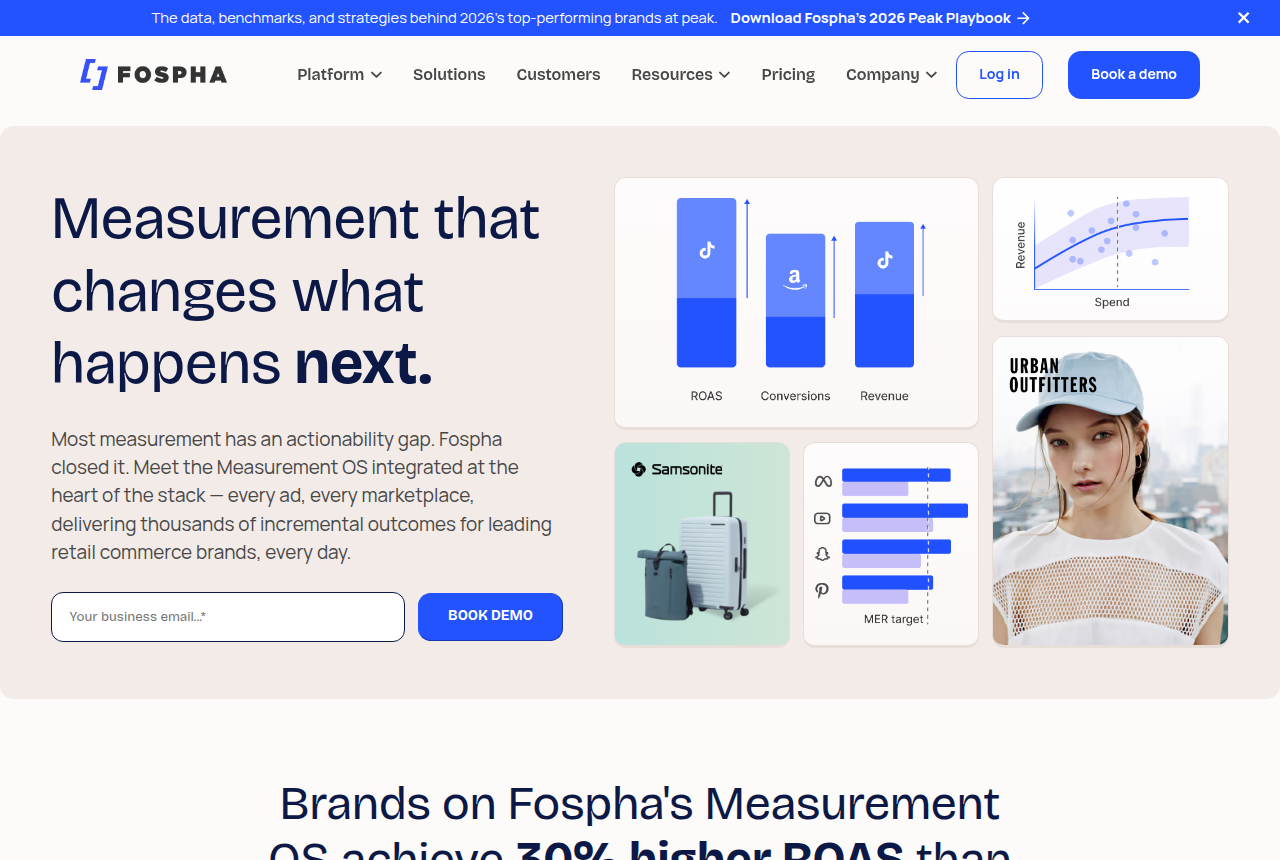
Fospha is a measurement platform for the same kind of brand, and it reaches its answer by the opposite route. It does not sit in the click path either, and it does not fire a pixel at all. It takes your real store revenue, your spend across every channel, and runs a daily marketing mix model that distributes credit for that revenue across the channels that earned it. It leans into the channels a pixel routinely undercounts: prospecting social, YouTube, upper-funnel display, and marketplace sales on Amazon and TikTok Shop. Where Polar leads with owned data and editable reporting, Fospha leads with pure modeled measurement and the widest view of the funnel, run for you rather than by you.
A reporting layer you own versus a managed model
This is the split under everything else. Polar is a data foundation with a pixel on top. You install its first-party pixel, tag your traffic, and it builds attribution and profit reporting you can edit, on a warehouse a data analyst can query directly past whatever the dashboards show. That is the appeal for a brand that wants to own its numbers and argue over one shared CAC and contribution-margin view. Its ceiling is attribution depth. Operators who ran it say it gets restrictive once the question turns to messy, business-specific attribution logic, and point to a data engineer or a heavier tool for that. On an r/FacebookAds thread one buyer put it plainly: Polar is "solid for visual reporting and has that 'one-click' shopify feel," but "can sometimes feel a bit restrictive if you need to go deep into the messy attribution stuff."
Fospha is the opposite trade. There is no pixel to install and nothing to maintain, because a marketing mix model does not follow individual users. It explains total revenue as a function of spend across channels over time and hands back a credit split. That is what lets it value prospecting social, YouTube and display that pixels undercount, and it is immune to the signal loss from iOS restrictions and ad blockers that erodes any pixel-based read, Polar's included. The cost is granularity and control. Fospha's view is directional at the channel level, not creative-level truth, and you cannot open a warehouse and rebuild a report yourself; the model is run for you. So the real question is whether you want a data foundation you operate, or a measurement service you receive.
What feeds the ad platforms
Here the two stop mirroring each other, and it matters to a media buyer. Polar's Advertising Signals sends conversion events server-side to Meta and Google, so the platforms optimize and match on a cleaner signal than the browser pixel gives them. For an operator whose Event Match Quality has slipped, that feed is a direct reason to lean Polar. Fospha does not do this. It is a measurement layer, not a conversion-API pipe, and it does not send conversions back to the ad platforms at all. If closing that loop is part of how you buy, only one of these two does it, and it is Polar. On the site's standard side-by-side that shows up as the server-side CAPI row: Polar carries it, Fospha shows a dash, because feeding the algorithms is not what a mix model is for.
Fospha's counterweight is reach. On its higher tiers it models the halo from paid media into Amazon and TikTok Shop sales, revenue a store-checkout pixel structurally cannot see, and it credits the upper-funnel demand-gen spend that a click-anchored read writes off. A brand pouring money into prospecting and marketplaces gets a truer channel-mix picture from Fospha than from any pixel. Polar sees your Shopify store well and the world beyond it barely.
Why your numbers will not match Meta or Shopify
Expect either tool to report fewer conversions than Meta or Google, sometimes far fewer, and to differ from Shopify too. That is not a bug in either one. The ad platforms each count a sale if someone clicked in a window or merely viewed an ad and later bought, so they all claim the same order. Polar and Fospha each apply one independent method across every channel, and the gap between that and the platforms is the over-attribution you are paying to see. What you reconcile against differs. Polar's numbers are pixel-anchored, so they need clean UTMs and its pixel installed or ad traffic falls into Direct or Unknown, and they line up more naturally with your ad accounts. Fospha's numbers are modeled estimates that will not reconcile to the cent by design, so a team running it needs a standing rule for which source wins when they disagree. Treat whichever you buy as the cross-channel decision layer, reconciled weekly against backend Shopify revenue, not a single source of truth.
Who each one is for
Polar is the fit when you own the store, want profit reporting on data you control, and want a cleaner signal fed back to Meta and Google. A Shopify brand past a few million dollars in GMV that has outgrown native reports and a spreadsheet, wants marketing and finance to share one CAC and contribution-margin dashboard, and wants Advertising Signals lifting its Event Match Quality, is exactly who it is built for. Its ceiling is attribution depth, so if business-specific attribution logic is the real problem, plan on a data engineer alongside it. See the full Polar Analytics review, how it reads against the popular Shopify command center in Polar Analytics vs Triple Whale, or the alternatives to Polar Analytics.
Fospha is the fit when you are a larger retail brand that has decided pixels can no longer settle your channel mix, and you want a model that credits demand-gen and marketplace revenue from your store's real numbers, managed for you. A brand spending $100,000 a month and up, running heavy upper-funnel and marketplace media, that wants channel-level truth without wiring or maintaining tracking, is exactly who it is built for. Its ceiling is granularity and the missing feedback loop: it does not read down to the creative, and it does not send conversions back to the platforms. See the full Fospha review or Northbeam vs Fospha for how it reads against a click-aware measurement platform. One caveat covers both. Below roughly $100,000 a month of spend, clean UTMs, server-side events and blended metrics like MER and new-customer CAC do most of the job for far less, and neither tool fixes a weak offer, a broken pixel setup or a low conversion rate. They make the numbers clearer. They do not make the funnel better.
What each one costs
Polar Analytics. Polar quotes after a demo and is tiered by your online GMV. The Shopify App Store listing shows a Core Plan from $750 a month, and a Shopify Plus operator on Reddit reported being quoted "in the 20k a year range." There is no free trial or free tier on the paid platform; the only free look is an instant demo running on sample data. What you get for that price is the warehouse, the semantic layer, the first-party pixel and Advertising Signals, not just a dashboard.
Fospha. Pricing is spend-banded with no self-serve tier. Lite starts at $1,500 a month and is aimed at brands spending roughly $100,000 to $500,000 a month on media; Pro adds an undisclosed percentage of ad spend on top of a $2,000-a-month base; Enterprise is quoted. There is no free plan and no trial, so the only way to validate it is to buy the onboarding.
On the way in these do not line up. Polar starts at $750 a month and Fospha at $1,500, and Polar's floor buys a tool you operate while Fospha's buys a service run for you. Higher up both scale with the size of the brand, so the number to weigh is the full quote for your GMV or spend level, not the entry line. Price the plan you would actually run against the problem you are actually solving.
Prices and buying terms checked on each vendor's own pages, current as of 27 September 2026.
Our pick
Polar Analytics
An ecommerce data platform that joins store, advertising and lifecycle records in a dedicated warehouse, then turns them into editable profit and marketing reports. Its first-party identity layer also sends selected conversions to Meta and Google. The trade-offs are quote-only GMV pricing and a reporting layer that users say can feel restrictive when attribution logic becomes highly specific.
Frequently asked questions
Polar Analytics or Fospha: which should I pick?
Are Polar Analytics and Fospha actually competitors?
Is Polar Analytics or Fospha cheaper?
Which one sends conversions back to Meta and Google?
Why won't Polar Analytics or Fospha match my Shopify and Meta numbers?
Sources
Other sources
4 discussions and reviews read for this page. Quotes are excerpts; open a link to read the original in context.
- [pa-home] Polar Analytics official site
- [fospha-home] Fospha | The Measurement Operating System for Retail Commerce
- [fospha-price] Fospha pricing
- [pa-restrictive] Polar Analytics attribution depth thread
How we compared these
We do not run paid campaigns through either tool. We read each vendor's own documentation and pricing, verify every number against the source, and weigh the long-term reports of operators who run them at real spend. The full rubric is on the methodology page.