Skip to content
Menu

Review

Polar Analytics review (2026)

By Marcus Flynn, tracking and attribution editor. Updated 23 September 2026.

Quick answer

ElasticFunnels is our top pick for most people. ElasticFunnels is a funnel platform for teams that buy traffic. It builds the pages, split-tests them under one URL, hosts the checkout with order bumps and multi-MID routing, and keeps the CRM, automations and attribution on the same data layer. It tops this list for a reason a tracker bolted onto a separate stack cannot match: a click, an order, a rebill and a refund are one record, so revenue reports per ad, page and variant without stitching four exports together. It is the pick when you are building the funnel anyway and want the numbers to come from the same place the sale happened.

  • ElasticFunnels. Best for Attribution built into the funnel. From $97/mo.
  • TrackPlay. Best for Attribution for VSL funnels. Has a free tier.
  • RedTrack. Best for Multi-channel paid-social buyers. Has a free tier.
  • Voluum. Best for Affiliate and native/pop/push buyers. From $119/mo.
  • Hyros. Best for High-ticket info, webinar and call funnels.
  • Binom. Best for High-volume affiliate and media buyers comfortable running a server. From $149/mo.
  • FunnelFlux. Best for Media buyers tracking complex, multi-step funnels. From $99/mo.
  • Northbeam. Best for Scaled DTC ecommerce brands. From $1,500/mo.
  • Polar Analytics. Best for Shopify brands centralizing profit and marketing reporting.
  • Triple Whale. Best for Shopify DTC brands wanting attribution and AI insights in one app. Has a free tier.
  • AnyTrack. Best for marketers who want server-side tracking without a developer. Has a free tier.
  • ClickFlare. Best for buyers who want flat, predictable pricing at scale. From $69/mo.
  • ClickMagick. Best for solo advertisers and small teams buying paid traffic to offers they own. From $79/mo.
  • Cometly. Best for B2B SaaS teams tying ad spend to Stripe revenue and CRM pipeline.
  • CPV Lab Pro. Best for Paid-traffic affiliates and media buyers who want a tracker they own and host themselves. From $57/mo.
  • Keitaro. Best for High-volume affiliate and media buyers who want a proven self-hosted tracker with hands-on support. From €40/mo.
  • Rockerbox. Best for Mid-market and enterprise brands running cross-channel media, including offline, that need unified measurement.
  • AdsBridge. Best for Budget affiliates who want tracking and landing pages in one tool. From $29/mo.
  • Fospha. Best for Retail and ecommerce brands spending six figures a month that want modeled measurement instead of pixels. From $1,500/mo.
  • Measured. Best for Mid-market and enterprise brands spending six figures a month across many channels that need causal measurement, not platform ROAS.
  • PeerClick. Best for Affiliate and iGaming media buyers who want automation-heavy click tracking. From $99/mo.
  • SegMetrics. Best for Info-product sellers, course creators, coaches and agencies who need person-level attribution and lead value across email-heavy, long-cycle funnels. From $57/mo.

Where Polar Analytics fits

An ecommerce data platform that joins store, advertising and lifecycle records in a dedicated warehouse, then turns them into editable profit and marketing reports. Its first-party identity layer also sends selected conversions to Meta and Google. The trade-offs are quote-only GMV pricing and a reporting layer that users say can feel restrictive when attribution logic becomes highly specific.

It is at its best for shopify brands centralizing profit and marketing reporting. That is the lens the rest of this review uses: not whether it is the biggest tool on the market, but whether it is the right one for that operator.

What Polar Analytics is

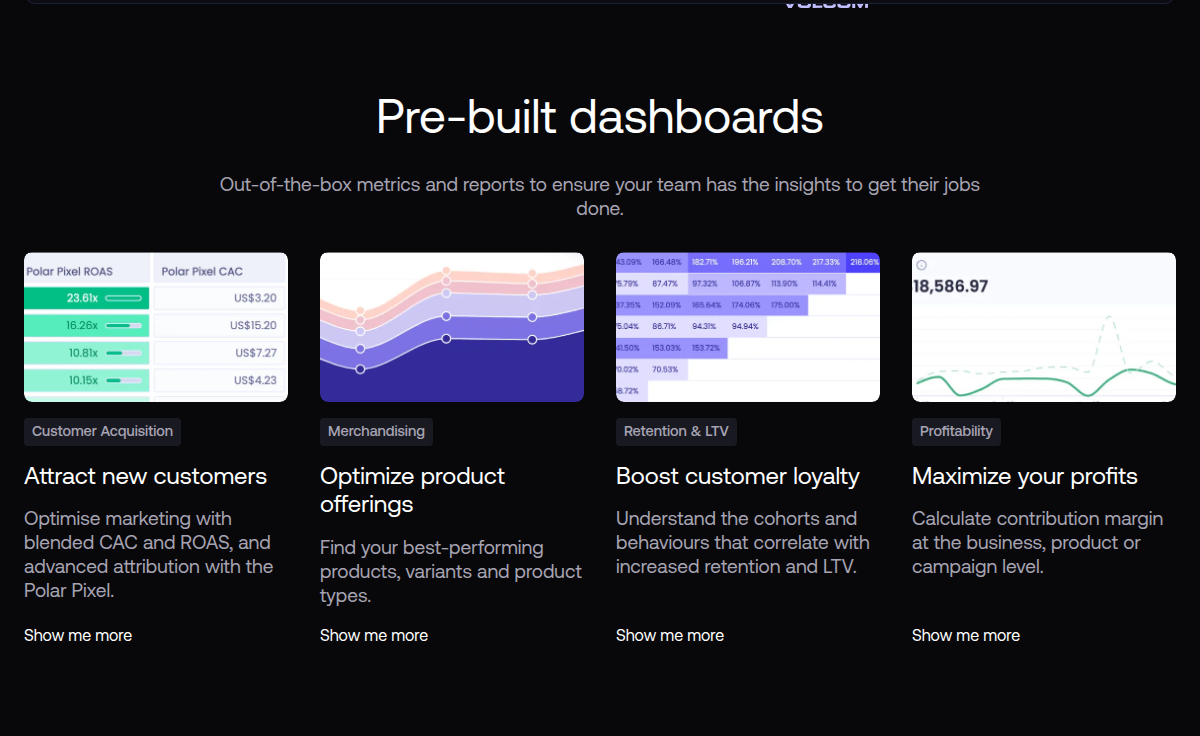
Polar Analytics is a Shopify-native analytics and business-intelligence platform for direct-to-consumer brands. It is not a redirect or click tracker like most of the tools on this site. It connects your store, ad platforms, email and the rest of your stack, then turns the lot into one set of dashboards: blended CAC and MER, ROAS, LTV, cohorts, retention and contribution margin, out of the box and editable. The pitch is to stop your team reconciling Shopify, Meta, Google, TikTok and Klaviyo by hand and give everyone one number to argue over.

Under the dashboards sits real infrastructure. Every plan includes a dedicated Snowflake warehouse you hold the keys to, an ecommerce semantic layer of pre-built metrics, and a first-party pixel with a Lifetime ID for cross-device tracking. On top of that, Advertising Signals pushes conversion events server-side to Meta and Google Ads to raise Event Match Quality, Klaviyo Audiences recovers abandonment events the native integration misses, and an incrementality-testing product runs lift tests with a data scientist attached.

Is it real, and who will regret buying it

It is real. Polar says it is used by more than 4,000 ecommerce brands and agencies, names customers like Jones Road Beauty, The Frankie Shop and RipnDip, and carries a 4.9 rating across roughly 117 reviews on the Shopify App Store. Operators who have run it call it, in their words, "solid for visual reporting" with a "one-click" Shopify feel. It is one of the two or three names a serious Shopify brand shortlists alongside Triple Whale.

The regret, when it comes, is almost always about two things: price and depth. On price, this is a mid-market and up product. The Shopify App Store listing shows a Core Plan from $750 a month, tied to your online GMV, and a Shopify Plus operator on r/shopify reported being quoted "in the 20k a year range". Merchants push back hard on paying analytics fees on revenue rather than on the reporting they actually use. If you are under a few million dollars in GMV, or you mainly need Shopify sales and ad spend in one view, cheaper tools, Looker Studio or native Shopify reports cover most of the value.

On depth, Polar is a reporting and BI layer more than a custom-attribution engine. Operators who ran both Polar and Triple Whale keep saying the same thing: they "get you so far but start to fall down when you need any form of customisation or nuance applied to your business". If your problem is messy, business-specific attribution logic, plan on a data engineer or a heavier tool rather than expecting Polar to model it for you.

Why your numbers will not match Shopify or Meta

Expect Polar's figures to differ from both Shopify and your ad platforms. Polar's own help docs are blunt that store and platform numbers diverge over revenue definitions, refunds, taxes, shipping, time zones and reporting logic, and that the gaps are usually reporting logic rather than missing data. Its attribution also needs discipline: ads without proper tracking parameters land under Direct or Unknown, and the first-party pixel has to be installed for session-level tracking. Skip the setup and the tool under-reports through no fault of its model. Treat it as the cross-channel decision layer, reconciled weekly against Shopify orders, not a single source of truth.

How it compares

Its real peers are the other ecommerce measurement suites: Triple Whale, plus Rockerbox and Daasity at the heavier end. On this site the closest tool is Northbeam, and the split is clean. Northbeam leads with multi-touch attribution and media-mix modeling for brands spending six or seven figures a month across many platforms, and it is priced accordingly. Polar leads with unified Shopify-native reporting and a data warehouse you can query, at a lower entry point, with attribution as one feature rather than the whole product. If your pain is which channel actually drove a sale at scale, look at Northbeam; if it is getting all your data into one profit dashboard your team will use, Polar fits better. For the full field, see the best ad tracking and attribution software, or the alternatives to Polar Analytics.
Pros and cons

What works

  • Joins ecommerce orders, ad spend, email and customer history in one semantic layer with editable reports for CAC, MER, LTV, cohorts, products and contribution margin.
  • Every plan includes a dedicated Snowflake database, unlimited users and unlimited historical data, so the business keeps an accessible data foundation rather than only a dashboard.
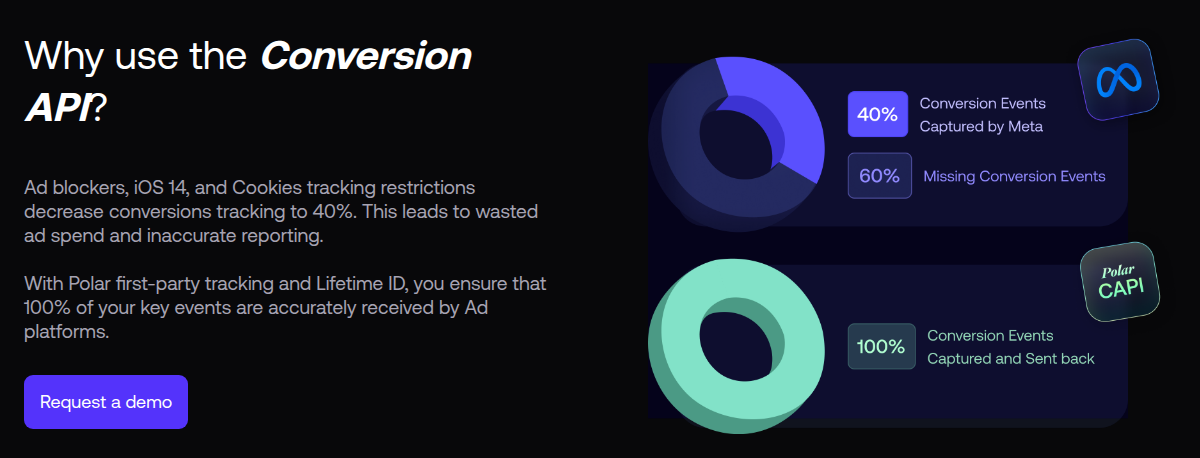
  • A first-party pixel and Lifetime ID improve identity, while Advertising Signals sends conversion events to Meta and Google Ads.
  • Incrementality Testing is available alongside Business Intelligence, with a dedicated data scientist and lift tests across digital, television and retail outcomes.

What to watch

  • The vendor publishes no dollar price. Quotes are tiered by annual gross merchandise value after a demo, which makes procurement less predictable as the store grows.
  • Operators praise the visual reporting but describe a ceiling when attribution needs custom logic or business-specific nuance. Polar now offers incrementality testing, but the broader platform still leads with ecommerce data and reporting.
  • Its center of gravity is ecommerce. A brand without owned order, product and customer data will use less of the warehouse, merchandising and lifecycle reporting.
  • The instant demo runs on sample data, not the buyer's store. A team still needs the sales process and implementation plan before it can validate its own connectors and definitions.
Polar's Conversion API explainer, with two donut charts contrasting 40% of conversion events captured by Meta alone against 100% captured and sent back through Polar's first-party CAPI, beside the Meta and Polar CAPI logos.
Advertising Signals conversion API. Polar's Conversion API explainer, with two donut charts contrasting 40% of conversion events captured by Meta alone against 100% captured and sent back through Polar's first-party CAPI, beside the Meta and Polar CAPI logos. Screenshot: polaranalytics.com,
Polar's pre-built dashboards, four cards showing Polar Pixel ROAS and CAC figures, a merchandising trend, retention and LTV cohort percentages, and a profitability contribution-margin chart reading 18,586.97.
Business Intelligence dashboards. Polar's pre-built dashboards, four cards showing Polar Pixel ROAS and CAC figures, a merchandising trend, retention and LTV cohort percentages, and a profitability contribution-margin chart reading 18,586.97. Screenshot: polaranalytics.com,

What users actually say about Polar Analytics

Research: unverified

A polished Shopify native reporting layer, not a deep attribution engine

Operators who ran both Polar and Triple Whale describe Polar as strong for visual reporting with a fast, one-click Shopify setup, but they hit a ceiling when they need messy custom attribution or business-specific nuance. It centralizes data well; it is not the tool people reach for when attribution logic gets complicated.

“i've actually used both, and while polar is definitely solid for visual reporting and has that "one-click" shopify feel, it can sometimes feel a bit restrictive if you need to go deep into the messy attribution stuff.”

Feeling-Juggernaut48 Reddit: TripleWhale vs. Polar Analytics

“I've used both, ultimately they get you so far but start to fall down when you need any form of customisation or nuance applied to your business.”

Significant_Mark9030 Reddit: TripleWhale vs. Polar Analytics

GMV based pricing feels like a revenue tax at Plus scale ↓ common complaint

The loudest recurring complaint is the pricing model. A Shopify Plus operator reported being quoted around $20k a year for Polar, and merchants object to analytics apps charging off gross merchandise value rather than the reporting they actually consume. Below serious scale the cost is hard to justify.

“I keep getting contacted by triple whale, we would need to pay a minimum of 30k a year for it. Polar analytics would be in the 20k a year range.”

NoMasTacos Reddit: Is it just me, or is the price for some apps getting obscene...

“Don't even get me started on the analytics apps that base the cost off of GMV.”

NoMasTacos Reddit: Is it just me, or is the price for some apps getting obscene...

Flexible, editable reports and support are the repeated praise ↑ frequently praised

Users like that Polar lets you build and edit any report rather than living inside fixed dashboards, and support comes up as a strength (the point the founder leans on when explaining Triple Whale switchers). Treat the founder's claim as biased, but the flexible-reporting point is echoed by independent users.

“i've actually used both, and while polar is definitely solid for visual reporting and has that "one-click" shopify feel, it can sometimes feel a bit restrictive if you need to go deep into the messy attribution stuff.”

Feeling-Juggernaut48 Reddit: TripleWhale vs. Polar Analytics

“We use first-party attribution and conversion API similarly, but some people prefer our UX, which tends to be more intuitive and flexible. (You can build and edit any report).”

savage_davdok (Polar founder, self-disclosed) Reddit: TripleWhale vs. Polar Analytics

What it costs

Pricing is tiered by annual gross merchandise value and quoted after a demo, and the pricing page publishes no dollar figure. The Core Plan bundles Business Intelligence, AI Agents and Data Activations, which the vendor says saves 20% on buying the products one by one. The Custom Plan lets a buyer pick products. Every plan includes a dedicated Snowflake database, an ecommerce semantic layer, a first-party pixel, unlimited users, unlimited historical data and a dedicated success manager. An instant demo runs on sample data without signup.

Prices read from the vendor's own pricing page and current as of 29 September 2026. Check the vendor before you buy; plans change.

See the full Polar Analytics pricing breakdown

Frequently asked questions

How much does Polar Analytics cost?
Pricing is tiered by annual gross merchandise value and quoted after a demo, and the pricing page publishes no dollar figure. The Core Plan bundles Business Intelligence, AI Agents and Data Activations, which the vendor says saves 20% on buying the products one by one. The Custom Plan lets a buyer pick products. Every plan includes a dedicated Snowflake database, an ecommerce semantic layer, a first-party pixel, unlimited users, unlimited historical data and a dedicated success manager. An instant demo runs on sample data without signup.
Does Polar Analytics offer a free trial?
No free trial is advertised.

How we reviewed this

We do not run paid campaigns through Polar Analytics. We read its own documentation and pricing, verify every number against the vendor, and weigh the long-term reports of operators who run it at real spend. The full rubric is on the methodology page.

Related reading

Marcus Flynn

Written by

Marcus Flynn

Tracking and attribution editor

Marcus Flynn runs OfferROAS's tracking and attribution desk. He has spent years close to direct-response paid media, and he reads the operator threads, vendor changelogs and pricing pages so you do not have to, then writes down what holds up once real budget runs through it. He owns the methodology and signs the site's money pages.

marcus@offerroas.com

Last checked 2026-09-23