Skip to content
Menu

Review

Measured review (2026)

By Marcus Flynn, tracking and attribution editor. Updated 28 September 2026.

Quick answer

ElasticFunnels is our top pick for most people. ElasticFunnels is a funnel platform for teams that buy traffic. It builds the pages, split-tests them under one URL, hosts the checkout with order bumps and multi-MID routing, and keeps the CRM, automations and attribution on the same data layer. It tops this list for a reason a tracker bolted onto a separate stack cannot match: a click, an order, a rebill and a refund are one record, so revenue reports per ad, page and variant without stitching four exports together. It is the pick when you are building the funnel anyway and want the numbers to come from the same place the sale happened.

  • ElasticFunnels. Best for Attribution built into the funnel. From $97/mo.
  • TrackPlay. Best for Attribution for VSL funnels. Has a free tier.
  • RedTrack. Best for Multi-channel paid-social buyers. Has a free tier.
  • Voluum. Best for Affiliate and native/pop/push buyers. From $119/mo.
  • Hyros. Best for High-ticket info, webinar and call funnels.
  • Binom. Best for High-volume affiliate and media buyers comfortable running a server. From $149/mo.
  • FunnelFlux. Best for Media buyers tracking complex, multi-step funnels. From $99/mo.
  • Northbeam. Best for Scaled DTC ecommerce brands. From $1,500/mo.
  • Polar Analytics. Best for Shopify brands centralizing profit and marketing reporting.
  • Triple Whale. Best for Shopify DTC brands wanting attribution and AI insights in one app. Has a free tier.
  • AnyTrack. Best for marketers who want server-side tracking without a developer. Has a free tier.
  • ClickFlare. Best for buyers who want flat, predictable pricing at scale. From $69/mo.
  • ClickMagick. Best for solo advertisers and small teams buying paid traffic to offers they own. From $79/mo.
  • Cometly. Best for B2B SaaS teams tying ad spend to Stripe revenue and CRM pipeline.
  • CPV Lab Pro. Best for Paid-traffic affiliates and media buyers who want a tracker they own and host themselves. From $57/mo.
  • Keitaro. Best for High-volume affiliate and media buyers who want a proven self-hosted tracker with hands-on support. From €40/mo.
  • Rockerbox. Best for Mid-market and enterprise brands running cross-channel media, including offline, that need unified measurement.
  • AdsBridge. Best for Budget affiliates who want tracking and landing pages in one tool. From $29/mo.
  • Fospha. Best for Retail and ecommerce brands spending six figures a month that want modeled measurement instead of pixels. From $1,500/mo.
  • Measured. Best for Mid-market and enterprise brands spending six figures a month across many channels that need causal measurement, not platform ROAS.
  • PeerClick. Best for Affiliate and iGaming media buyers who want automation-heavy click tracking. From $99/mo.
  • SegMetrics. Best for Info-product sellers, course creators, coaches and agencies who need person-level attribution and lead value across email-heavy, long-cycle funnels. From $57/mo.

Where Measured fits

An enterprise media-effectiveness platform built around causal incrementality experiments and a test-calibrated media mix model. It is the stronger method when leadership needs to prove lift across digital, connected television, audio or offline channels. The trade-offs are quote-only buying, heavy data preparation and no conversion-feedback product for ad auctions.

It is at its best for mid-market and enterprise brands spending six figures a month across many channels that need causal measurement, not platform roas. That is the lens the rest of this review uses: not whether it is the biggest tool on the market, but whether it is the right one for that operator.

What Measured is

Measured is a media-effectiveness platform for mid-market and enterprise brands. It does not sit in your click path like a tracker such as Voluum or RedTrack, and it does not fire a pixel to claim conversions. It answers a harder question: across Meta, Google, TikTok, connected TV, affiliates, email and offline, which channels are actually causing sales, and which are taking credit for sales that would have happened anyway.

It does that by combining two methods on one system, which the company calls triangulated measurement. The first is incrementality testing: real-world geo-matched and first-party split tests, with holdouts, that measure the true lift a channel drives instead of a modeled estimate. The second is media mix modeling that is calibrated by those experiments, so the model is anchored to causal evidence rather than to correlations alone. On top of that sit a Media Plan Optimizer that recommends where and how much to spend, cross-channel reporting, and peer benchmarks. The result is one number your marketing and finance teams can plan against.

The reason it exists is a real problem. Every ad platform reports on its own conversions, so Meta, Google, TikTok and the rest collectively claim more sales than your store actually made. Last-click reporting swings the other way and hands the credit to brand search, direct and retargeting, starving the upper-funnel spend that created the demand. A lift test settles the argument by measuring what happens when you turn a channel off, and Measured is built to run those tests continuously and feed them into planning.

Is it legit? The trust question, answered

If you are asking whether Measured is real and safe to pay for, the answer is yes. It is an established platform with a genuine product and a client list of recognisable brands, from Dermalogica and Steve Madden to Overstock and MARS. On G2 it holds 4.9 out of 5, and AdExchanger, a trade outlet that covers this category closely, reported on its revamped platform and voted it #1 in Measurement and Analytics. Independent review coverage lines up with the pitch. There is no scam story here.

The honest tension for a paid-traffic operator is not legitimacy, it is fit and cost. Measured is an enterprise tool sold the enterprise way: a booked demo, an annual contract, and a serviced onboarding rather than a self-serve sign-up. The outside record is credible but concentrated on G2, vendor case studies and trade press, and thin on the candid operator-to-operator threads you would normally cross-check against. That is a reason to lean on references and a structured pilot before you sign, not a reason to distrust the company. It clears the trust bar. The work is proving it fits your business.

Who it is for, and who it is not

Measured fits a specific brand. If you spend at least six figures a month on media, sell across several channels, and want to know the causal contribution of each one rather than the number each platform reports, this is the shape it is built for. It fits even better if you run channels a pixel struggles with, such as connected TV, podcasts, direct mail or upper-funnel prospecting, because a geo lift test can measure those where click attribution cannot. And it suits a team where finance keeps challenging marketing's numbers, because a test-calibrated model is exactly what settles that argument.

It is the wrong tool for a lot of readers of this site. If you run one Shopify store on Meta and Google, a clean pixel plus each platform's Conversion API covers most of the value for a fraction of the cost. If you buy traffic to offers across affiliate networks, you want a click tracker, not a measurement layer, and something like Voluum or self-hosted Keitaro is the right choice. And if your monthly media spend is below roughly six figures, third-party analysis of the category says plainly that the spend threshold locks smaller brands out. If it is not the fit, the Measured alternatives worth weighing are ranked by who each one suits, and Fospha and Rockerbox sit closest to it.

What buyers actually report

Read the outside record as signal, and remember most of it lives on G2 and in trade coverage. The praise is consistent. Reviewers value the triangulated approach, where geo experiments calibrate the mix model so a budget call rests on causal evidence, and they credit the team as much as the software. One buyer, quoted by Incrementality Platforms, said the team knew their stuff better than anyone and made onboarding feel comfortable. Case studies describe brands finding incremental ROI in channels they had overlooked, though those are the vendor's own selection and should be read that way.

The criticism is worth knowing before you commit. The recurring frustration is the setup: getting spend and conversion data connected across every network is manual and slow. One G2 reviewer called that work an absolute nightmare and described having to pull reports from every single network to share with Measured. That is the price of a model that reads from all your data, but it is real effort a lean team will feel. The other theme is more fundamental to the category than to Measured: experiments and mix models produce estimates and confidence intervals, so the numbers will not reconcile with Meta, GA4 or Shopify, and buyers who cannot tolerate modeled figures over deterministic ones will chafe with any tool in this space.

What it costs

Measured does not publish a price, and that is the single most important fact for a buyer weighing it. G2 records that the company has not provided pricing information, so you contact sales for a quote. Pricing is enterprise-level, contracts are annual, and the figure scales with your media spend and the number of channels you measure. There is no free trial and no self-serve tier, so the only way to see it work on your own data is to buy it.

Independent estimates give a rough shape, and they are third-party figures rather than the vendor's, so treat them as directional. Category analysts put a practical minimum around six figures of monthly digital spend, and circulate annual contract figures ranging from the low six figures into the mid six figures depending on channel count. The takeaway is not a precise number, it is that the entry point is the real filter here, not the software. For the plan-by-plan picture and the questions to ask on the demo, see the Measured pricing page, and for where it lands against the wider field, the best ad tracking and attribution software roundup.

Changelog

  • 28 September 2026: First published. Product facts read from Measured's own site on 27 September 2026, and user sentiment weighed from G2, AdExchanger and public discussion.

Pros and cons

What works

  • Causal experiments and media mix modeling work together, so budget recommendations are checked against observed lift rather than trusted from one modeled number.
  • Measures channels that may leave no useful click path, including connected television, audio, offline and upper-funnel media.
  • The Media Plan Optimizer turns saturation and diminishing-return curves into channel-allocation recommendations.
  • A serviced implementation gives the brand methodological support for experiment design, market selection and stakeholder adoption.

What to watch

  • The vendor publishes no price, self-serve plan or free trial. Buyers start with a demo and need the full platform fee, experiment scope, onboarding work and contract terms in writing.
  • Independent coverage flags a high entry barrier, so a small advertiser may not have enough spend, conversion volume or geographic spread for useful holdout tests.
  • Onboarding is data-heavy. User reports describe substantial work gathering spend and outcome reports across networks before the first useful read.
  • The output is modeled and experimental, so it will not reconcile to Meta, GA4 or Shopify. The vendor pages we checked do not promise to send conversions back to ad platforms.
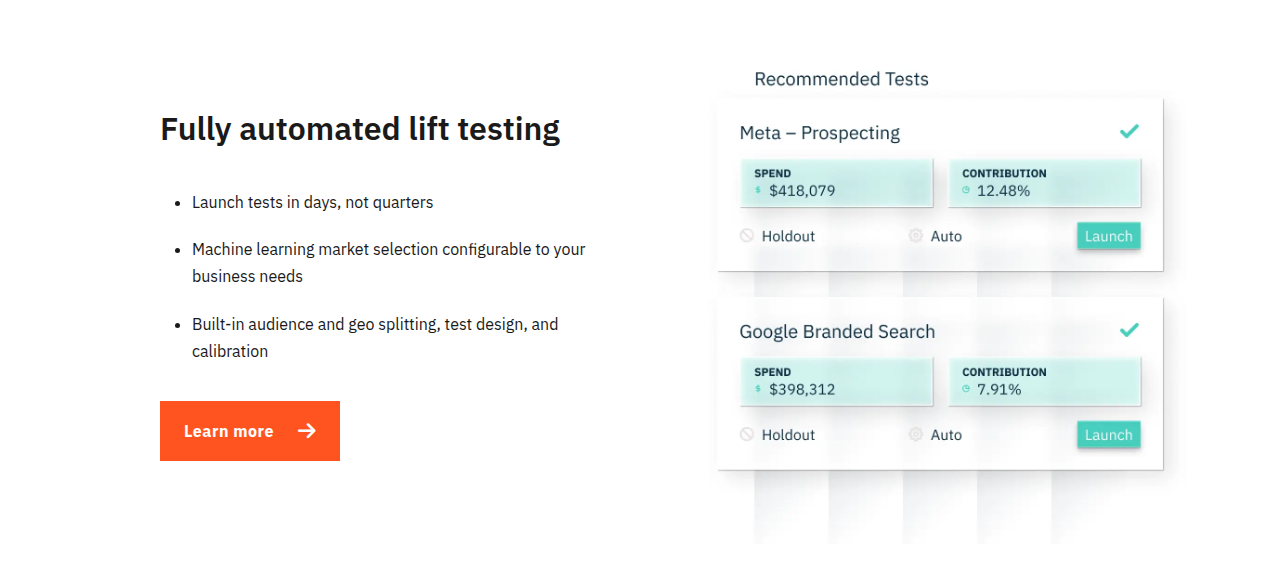
A "Recommended Tests" panel with cards for Meta Prospecting and Google Branded Search, each showing spend, incremental contribution percentage, holdout and auto toggles, and a Launch button.
Incrementality testing. A "Recommended Tests" panel with cards for Meta Prospecting and Google Branded Search, each showing spend, incremental contribution percentage, holdout and auto toggles, and a Launch button. Screenshot: measured.com,
A diminishing-returns spend curve labeled Incremental Sales and Incremental ROAS with an Optimal Spend Level marker, under the heading 'Know where to spend, and how much.'
Media plan optimizer. A diminishing-returns spend curve labeled Incremental Sales and Incremental ROAS with an Optimal Spend Level marker, under the heading 'Know where to spend, and how much.' Screenshot: measured.com,

What users actually say about Measured

Research: unverified

Triangulated measurement is the draw ↑ frequently praised

Reviewers value that Measured combines geo-based incrementality experiments with test-calibrated media mix modeling on one platform, so a budget decision is cross-checked against a causal read rather than a single modeled number. Industry coverage frames the revamped platform as blending automation, incrementality and MMM.

“knew their stuff better than anyone”

Incrementality Platforms Blog: Measured - Incrementality Platforms Reviews

“Measured's revamped platform blends automation, incrementality and MMM”

AdExchanger Blog: Measured's Revamped Platform Blends Automation, Incrementali...

Onboarding and data work are heavy ↓ common complaint

The most consistent complaint is the setup: connecting spend and conversion data across every network is manual and slow, with one reviewer calling it an absolute nightmare and describing pulling reports from every network to share with Measured. The payoff is real but front-loaded.

“an absolute nightmare”

G2 reviewer G2: Measured Media Mix Modeling & Incrementality Reviews

“pull reports from every single network and share them with Measured”

G2 reviewer G2: Measured Media Mix Modeling & Incrementality Reviews

The team is a real part of the product ↑ frequently praised

Buyers repeatedly credit the Measured team for knowing the methodology better than anyone and for making onboarding feel comfortable, educating stakeholders and winning internal buy-in. This is a serviced platform, not self-serve software.

“knew their stuff better than anyone”

Incrementality Platforms Blog: Measured - Incrementality Platforms Reviews

Priced and gated for the enterprise ↓ common complaint

Measured publishes no price; G2 states it has not provided pricing information and users must contact the company. Third-party analysis flags a high minimum spend barrier that locks out smaller brands, so the entry point is the real filter, not the software.

“Measured has not provided pricing information for this product or service.”

Anonymous G2: Measured Media Mix Modeling & Incrementality Pricing

“high minimum spend barrier”

SegmentStream Blog: 9 Best Measured Alternatives & Competitors for Incrementalit...

What it costs

No public price or self-serve plan is published. Access starts by booking a demo; the vendor does not advertise a free trial.

Prices read from the vendor's own pricing page and current as of 29 September 2026. Check the vendor before you buy; plans change.

See the full Measured pricing breakdown

Frequently asked questions

How much does Measured cost?
No public price or self-serve plan is published. Access starts by booking a demo; the vendor does not advertise a free trial.
Does Measured offer a free trial?
No free trial is advertised.

How we reviewed this

We do not run paid campaigns through Measured. We read its own documentation and pricing, verify every number against the vendor, and weigh the long-term reports of operators who run it at real spend. The full rubric is on the methodology page.

Related reading

Marcus Flynn

Written by

Marcus Flynn

Tracking and attribution editor

Marcus Flynn runs OfferROAS's tracking and attribution desk. He has spent years close to direct-response paid media, and he reads the operator threads, vendor changelogs and pricing pages so you do not have to, then writes down what holds up once real budget runs through it. He owns the methodology and signs the site's money pages.

marcus@offerroas.com

Last checked 2026-09-28